

Inequality in Japan
Have you ever felt that there is an income disparity in Japan, and that it is widening?
In fact, Japan is said to have the second largest gap between the rich and the poor after the United States.
Can you believe this?
There are some people who can believe it, but I think there are many people who don't really feel it.
Let's take a look at Japan's poverty rate.
Japan in terms of Relative Poverty Rate
In 1994, 13.8% of the population lived in relative poverty (having less than half of the average income), but in 2000, 15.3% lived in relative poverty, and in 2012, 16.1% lived in relative poverty.
Trends in Japan's Relative Poverty Rate
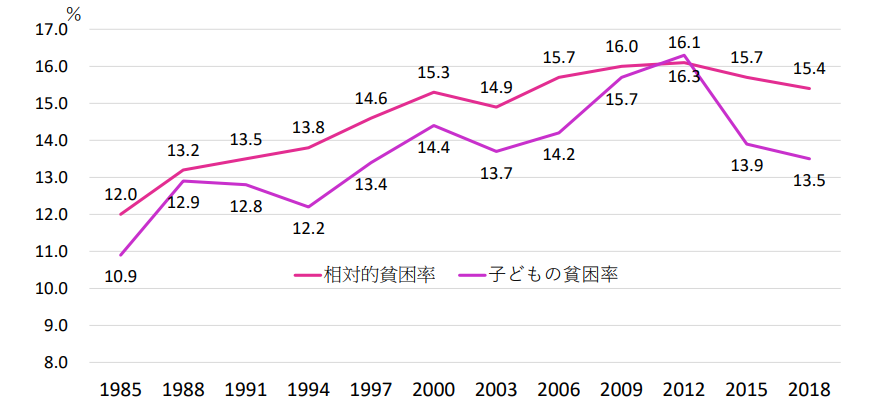 Relative Poverty Rate in Japan From the 2019 National Survey on Living Standards, Ministry of Health, Labour and Welfare
Gini Coefficient in Japan
The Gini coefficient clearly shows that the gap between the rich and the poor is widening.
The Gini coefficient of annual income in Japan (for households with two or more people) was 0.271 in 1979, 0.301 in 1999, and 0.314 in 2014, and it has been increasing every year.
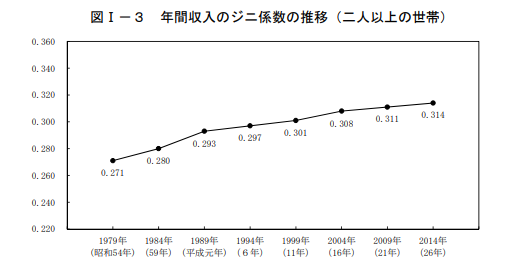 From "Results of the 2014 National Survey of Actual Consumption," Statistics Bureau, Ministry of Internal Affairs and Communications
From these data, we can see that the gap between the rich and the poor in Japan is widening year by year.
In other words, Japan is not a country of equality.
Equality of Opportunity" is being lost in Japan.
It is believed that Japan is losing its equality of opportunity compared to the past.
I think this is more evident in education and employment.
I would like to use these as examples to explain the current loss of equality of opportunity.
Education
In today's Japan, children of parents with higher incomes have a greater chance of receiving a good education.
This is because parental income has a significant impact on the desire for higher education.
Children of families with higher incomes can go to cram schools, buy reference books when they want, and easily create an environment where they can improve their academic skills.
In other words, they are given the opportunity to receive an education.
However, children of parents with low income are not given the opportunity to receive a good education.
In fact, the percentage of correct answers in math B (questions that require application skills) in the sixth grade is about 72% for children whose household income is over 15 million yen.
In contrast, the rate is about 46% for children from households with an annual income of less than 2 million yen.
In addition, the percentage of correct answers in the third grade of junior high school in Mathematics B (also a question that requires application skills) is about 53% for children from households with an annual income of 15 million yen or more. In contrast, the percentage for children from households with an annual income of less than 2 million yen is about 30%.
Employment
Education is an important factor in finding a job in Japan today.
However, as long as education is influenced by parental income, it must be said that parental income also influences employment.
These are the main reasons why equality of opportunity is said to be lost in education and employment.
Children with low incomes are denied various opportunities compared to children with high incomes.
Causes of the widening disparity in Japan
It is said that the cause of the widening disparity in Japan is the promotion of free competition in the private sector.
Free competition can be expected to promote economic growth and lower prices of various goods and services.
In other words, it can enrich our lives.
On the other hand, as companies compete with each other for survival, those who lose the competition will not survive.
The expansion of competition in various fields is considered to be one of the causes of the widening gap in Japan.
Free competition has both great advantages and great disadvantages. This is one of the difficulties of the disparity issue.
Back

©Let's eliminate international divide!
We are participating in the 24rd Japan Junior High School / High School web contest